
Why Does Your Back Keep Going When You Exercise?
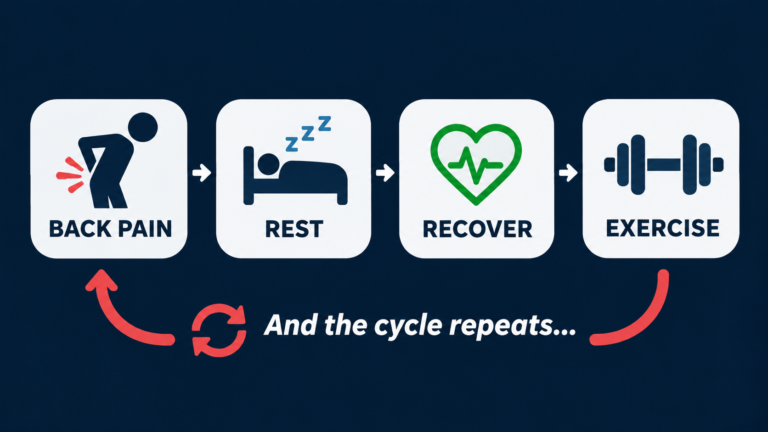
Your back goes, you rest, you recover, you get back to exercise… and your back goes again. 🤦♂️
Sound familiar?
It’s an incredibly frustrating cycle, especially when you know exercise is supposed to be good for your back!
Whether it’s running, cycling, Pilates, going to the gym or playing sport, the cycle is often the same.
So why does it keep happening, and more importantly, how do you break it?
Well, one of the biggest things to understand is that just because your pain has settled down, it doesn’t necessarily mean you’re ready to go back to doing everything you were doing before.
Your tolerance to certain movements and loads might still need rebuilding.
And this is where a lot of people go wrong.
Your weakest link
Imagine you used to run marathons, half marathons or regularly knock out a 10K without any trouble.
Then you develop back pain, or some other injury, which stops you running for a while.
Eventually things settle down, you’re feeling good and decide it’s time to get back out there.
You used to run marathons, so surely a little 10K isn’t going to be a problem?
Well, sadly, it might be.
Your general fitness might still be excellent, your legs might feel great, but the tissues that have been giving you trouble might not be ready for that 10K just yet.
And as humbling as it might be, you could be better off starting with something like Couch to 5K (As outlined in last weeks ramble).
Yes, that’s probably going to be frustrating, and yes, if you’ve got a good level of fitness you might work through it much more quickly than a complete beginner.
But you need to start small, see how your body responds, then add a little more, and gradually build that tolerance again.
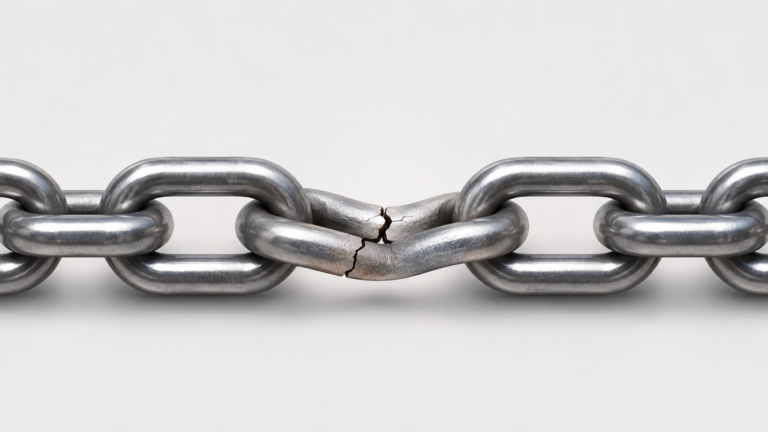
It’s a bit like a chain.
You can have ten really strong links, but if one is weak, that’s the one that’s going to let you down when you start putting it under stress.
And that’s the link you need to work with.
I’ve made this mistake myself!
When I was suffering with back pain, I’d start to feel a bit better and think it was time to go and play rugby again.
So off I’d go.
And quite often I’d end up right back at square one, if not worse! Lying on the floor of my lounge in the evenings, feeling miserable.
What I really needed to do was go back to training first, take things fairly easy, avoid contact initially and gradually build up the intensity over a number of weeks.
Then perhaps introduce some contact, a little game time, and eventually build back towards a full 80 minutes.
Rather than just jumping straight back in because my back wasn’t hurting anymore.
I eventually took this approach when I started deadlifting again.
I began with just 30kg. A 10kg bar with a couple of 10kg plates.
Now, I was certainly capable of lifting more than that. The rest of my body was strong enough, and I didn’t feel like I was working particularly hard.
But I stuck with it.
I gradually increased the weight, always by just 2.5kg at a time (1.25kg each side!), and I’d have to manage that weight at least twice without any problems before increasing it again.
Painstakingly slow! 🥱
There were plenty of times when I thought I could just stick another couple of 10kg plates on and get on with it.
But I didn’t.
And eventually I built that deadlift up to around 170kg, without my back constantly kicking off.
Considering I’d spent around five years suffering debilitating back pain and was once absolutely terrified of deadlifting, that’s not bad going!
Graded exposure, progressive overload and a LOT of patience.
That’s what helped me rebuild my tolerance to loading my back.
And it’s the same principle whether you’re returning to running, sport, the gym or simply trying to get back to everyday activities.
I’ve used this same method multiple times now to come back from a variety of injuries, and helped others do the same.
A few other things worth considering
Another mistake I see quite often is people stopping their rehabilitation exercises as soon as they start to feel better.
You go to a physio, get some exercises, do them for a couple of weeks, things improve and… you stop.
Then things kick off again.
Perhaps those exercises needed to continue for longer, maybe they needed progressing, or perhaps they could become part of your regular routine before exercise.
And this is where I think the real value of physiotherapy comes in.
It’s not necessarily the hands-on treatments, needles or whatever else you might have done.
It’s the assessment, the advice, the coaching, the progression and being able to change the plan when something isn’t working.
A physio doesn’t always know exactly what’s going on or what the perfect solution is after one appointment. Sometimes it’s a case of trying an approach, seeing how you respond and adjusting things as you go.
That’s why actually working with a good physio over time can be so valuable.
Another thing is becoming too focused on your back itself.
People are constantly looking for the ‘best back pain stretch’ or the ‘one exercise’ that’s going to fix everything.
Well, it’s probably never going to be that simple!
Your whole body needs attention, and things like general strength, movement, sleep, stress, nutrition and recovery all play a part.
Small improvements across the board rather than absolute perfection.
And finally, don’t become afraid of movement.
I spent years being scared of bending, lifting and loading my back, and looking back I genuinely think that fear held me back from recovering for a very long time.
If bending is something that causes you trouble, for example, we don’t necessarily want to avoid bending forever.
We want to gradually reintroduce it. Find a range that feels manageable, work within that and slowly build things up.
Teach your body that it can handle those movements again.
Progress is going to be messy!
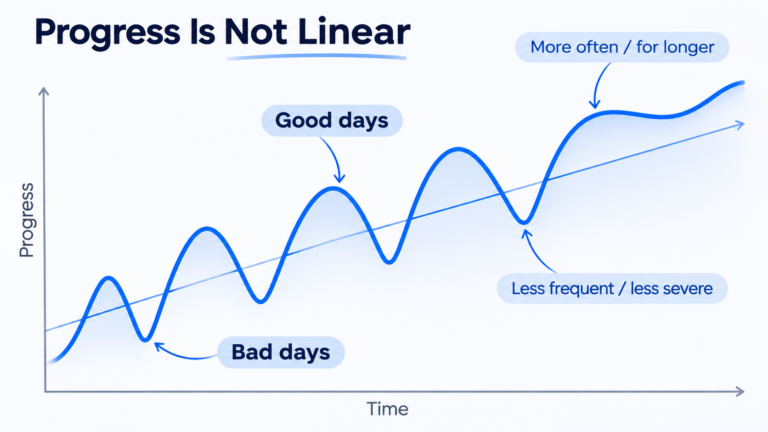
Something else that’s really important to understand is that recovery isn’t necessarily linear.
It’s going to be a bit up and down, a bit wavy, a bit bumpy.
What we want to see over time is more good days, fewer bad days, less severe flare-ups and a quicker bounce back when things do kick off.
Not every time something gets a little uncomfortable, throwing the toys out of the pram and thinking you’re back at square one!
Sometimes you’ll need to back off, reduce the weight, go a bit easier on your run or take an extra recovery day.
That’s fine.
Some discomfort during recovery is quite normal, but it shouldn’t be continually worsening or leaving you significantly worse off. If symptoms persist or worsen, it’s worth getting assessed.
The important thing is that you keep gradually building your capacity rather than constantly going through that boom-and-bust cycle.
So, my main advice?
Find a starting point that your body can currently manage. Start easier than you think you need to, build up gradually, and adjust things as you go.
And be patient.
Probably the hardest bit of all
I’ll leave you with one final thought, which I think sums this up quite nicely:
Stop constantly testing whether your back is better, and start training it to do what you want it to do.
I wish I’d understood that a lot earlier in my own back pain journey.
If you’re struggling with recurring back pain and aren’t sure how to get moving again, please feel free to get in touch. We could discuss 121 coaching if needed.
Russ@Pilatesguy.co.uk